
Kick-off
The Inspiration
Semideus is not something I started out of nowhere. And for sure is not my invention. Yet, it has roots on different sources I found and read, and which i strongly believe are extremely interwined. The sources are the following
- Homo deus — A book from Noah Harari
- Solve Everything Blueprint - https://solveeverything.org
- Deep Utopia - A book from Nick Bostrom
Semideus stems from some ideas found in the above sources. Semideus is an attempt to treat some elements of human optimization as a Big Data Processing System. First it tries to treat various behaviours and actions we do, into a unified data system. In this way , smart algorithms (such as AI agents) can help us optimize these elements.
That fragmentation isn't just inconvenient , it's the fundamental flaw in how we approach human optimization. We treat ourselves as a collection of disconnected systems rather than what we actually are: one integrated organism trying to evolve.
That's why I built Semideus.
What Is Semideus?
Semideus is try to define the rails and the "skeleton" a collective of data of an individual. The vision behind Semideus is to provide an easy connection of the data to instruments of machine (or whatever type) intelligence.
The platform is built around 3 Pillars:
- Body — Training, nutrition, health metrics, readiness scoring
- Cognition — Learning projects, spaced-repetition flashcards, teach-back sessions
- Discipline — Protocols, streaks, daily commitments, consistency scoring
Why I Built It
I'm not building this because the market needs another app. I'm building it because the premise behind most self-improvement tools is fundamentally broken.
They treat optimization as a series of isolated habits. Do your pushups. Track your macros. Read for 20 minutes. Check the box. But real human performance doesn't work in checkboxes. It works in systems. I think everything does in the low level
An athlete who trains hard but sleeps poorly and eats inconsistently will plateau. A learner who studies relentlessly but never recovers mentally will burn out. The bottleneck is never where you think it is, and it's almost never within a single domain.
Semideus is designed to find those bottlenecks. When your training consistency is high but your HRV is dropping, the system recognizes you need recovery, not another workout. When your learning scores plateau, it might identify that your sleep quality or stress levels are the actual constraint.
The Data: How The System Changed My Own Body
I've been dogfooding Semideus for the past month. Here's what happened when I stopped optimizing in silos and let the system coordinate everything.
Body Fat: 20% → 16.8% in Two Weeks
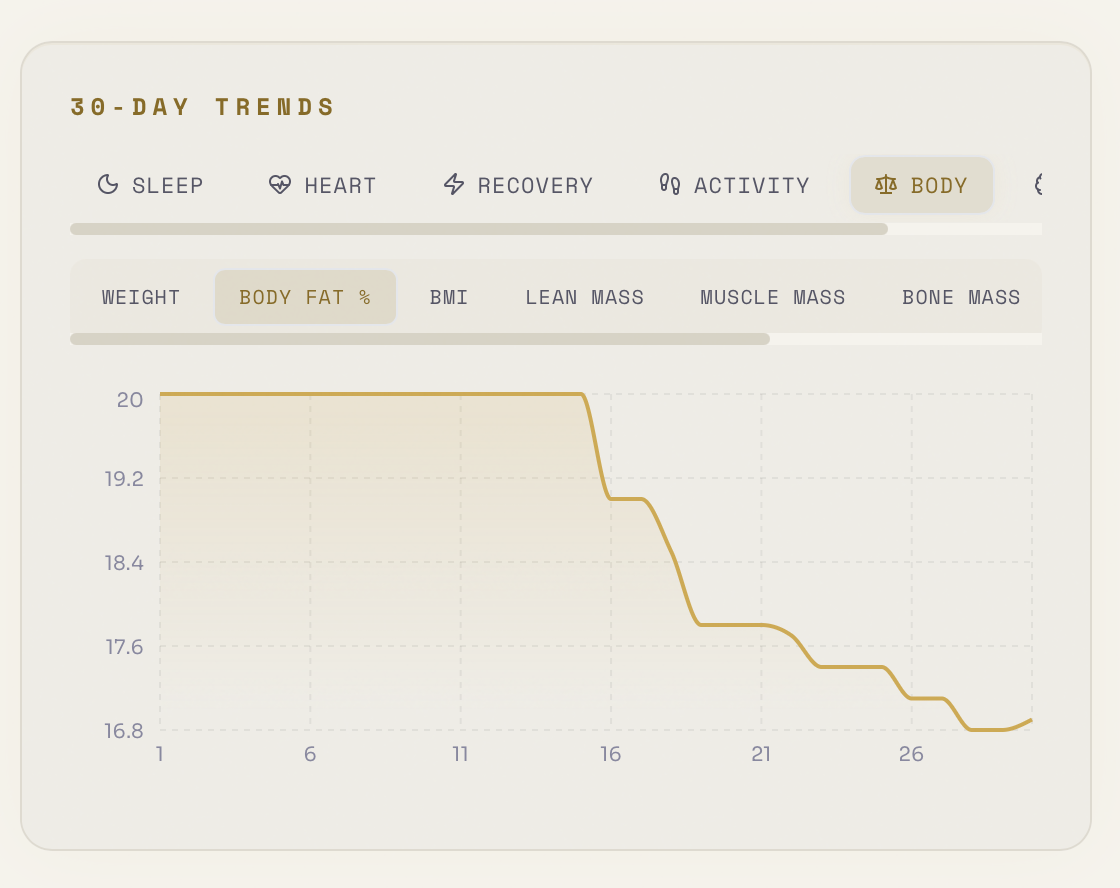
This is the metric I'm most proud of. My body fat percentage dropped from ~20% to ~16.8% in roughly two weeks — while maintaining and even slightly increasing muscle mass. That's the holy grail of body recomposition, and it didn't come from some extreme diet or crash protocol. And it came by a protocol produced by artificial intelligence.
It came from the system. Nutrition targets aligned with training load. Recovery protocols adjusted based on readiness. The Discipline pillar kept me accountable. Everything worked together instead of fighting each other.
HRV: Baseline 60ms → 70ms
My Heart Rate Variability was flatlined around 60ms for the first three weeks. Then, as the body recomposition protocols took hold and recovery improved, it jumped to ~70ms , a 15%+ improvement in autonomic nervous system health. Higher HRV means better recovery, better stress resilience, and better overall cardiovascular fitness.
This wasn't random. The system detected that my recovery was lagging behind my training intensity and adjusted my protocols accordingly. When the system works, HRV follows.
Active Calories: 50-100/day → 750-900/day
My daily active calorie burn went from a sedentary 50–100 calories per day to consistently hitting 700–900. The increase wasn't linear , it ramped gradually as the system increased training load in step with improving recovery scores. This is what intelligent programming looks like: push harder only when the body is ready for it.
The Key Insight
None of these improvements came from optimizing a single variable. They came from the cross-pillar approach , where nutrition, training, recovery, sleep, and discipline protocols all inform each other.
The body fat dropped because nutrition was dialed in relative to training load. The HRV improved because recovery was prioritized when readiness dipped. The activity increased because the system could push harder as the foundation strengthened. This is what systems-level thinking looks like in practice.
But the technology is in service of something bigger. The vision is a platform where AI doesn't just track your habits — it architects your evolution across every dimension of being human. Every pillar feeding data into a unified intelligence that knows you better than any single app ever could.